
leave a message
If you are interested in our products and want to know more details,please leave a message here,we will reply you as soon as we can.

From diagnostic access and lesion crossing to balloon dilation and stent delivery, a complete PCI product portfolio helps distributors, importers, and healthcare suppliers build a more efficient coronary intervention supply chain.
What Is a Complete PCI Product Solution?
A complete PCI product solution is not simply a collection of individual coronary intervention devices. It is an integrated product portfolio designed to cover the key device requirements involved in percutaneous coronary intervention (PCI), including vascular access, coronary angiography, lesion crossing, balloon treatment, stent delivery, and procedural support. Many distributors mistakenly treat PCI portfolio as a simple list of separate devices. In real‑world procurement, compatibility, regulatory readiness and stable supply matter far more than just having every SKU on paper.
PCI, or percutaneous coronary intervention, is a catheter-based procedure used to treat narrowed or blocked coronary arteries[1]. Depending on the procedure and clinical situation, coronary intervention may involve guiding catheters, coronary guidewires, balloon catheters, coronary stents, microcatheters, guide extension catheters, inflation devices, and other accessories.
For medical device distributors and importers, the challenge is often not finding one PCI product. The real challenge is building a stable, compatible, and commercially viable product portfolio that can support different coronary intervention scenarios.
That is where a complete PCI product solution becomes valuable.
We frequently hear feedback from our B2B partners: they can easily source single guidewires or balloons, yet struggle to source a full set of mutually compatible devices with unified regulatory documentation from one single manufacturer. Fragmented sourcing creates extra work for registration, quality auditing and shipment coordination.
The PCI Product Portfolio at a Glance
A typical PCI product portfolio can be organized into several functional groups:
| Product Category | Primary Role in PCI | Typical B2B Requirement |
| Diagnostic Catheter | Coronary angiography and diagnostic access | Multiple shapes and specifications |
| Guiding Catheter | Provides access and support for intervention | Size, shape, support and compatibility |
| Coronary Guidewire | Lesion crossing and device delivery support | Workhorse, hydrophilic, specialty options |
| Microcatheter | Support for complex lesion and wire management | CTO and complex intervention applications |
| Guide Extension Catheter | Additional distal support and device delivery assistance | Different lengths and compatibility |
| Balloon Catheter | Lesion preparation and dilation | Diameter, length and pressure range |
| Coronary Stent | Scaffold to maintain vessel patency | Different diameters, lengths and delivery systems |
| Inflation Device | Controlled balloon inflation and pressure monitoring | Reliable pressure control |
| Y-Connector / Accessories | Connection and procedural support | Compatibility and complete-set supply |
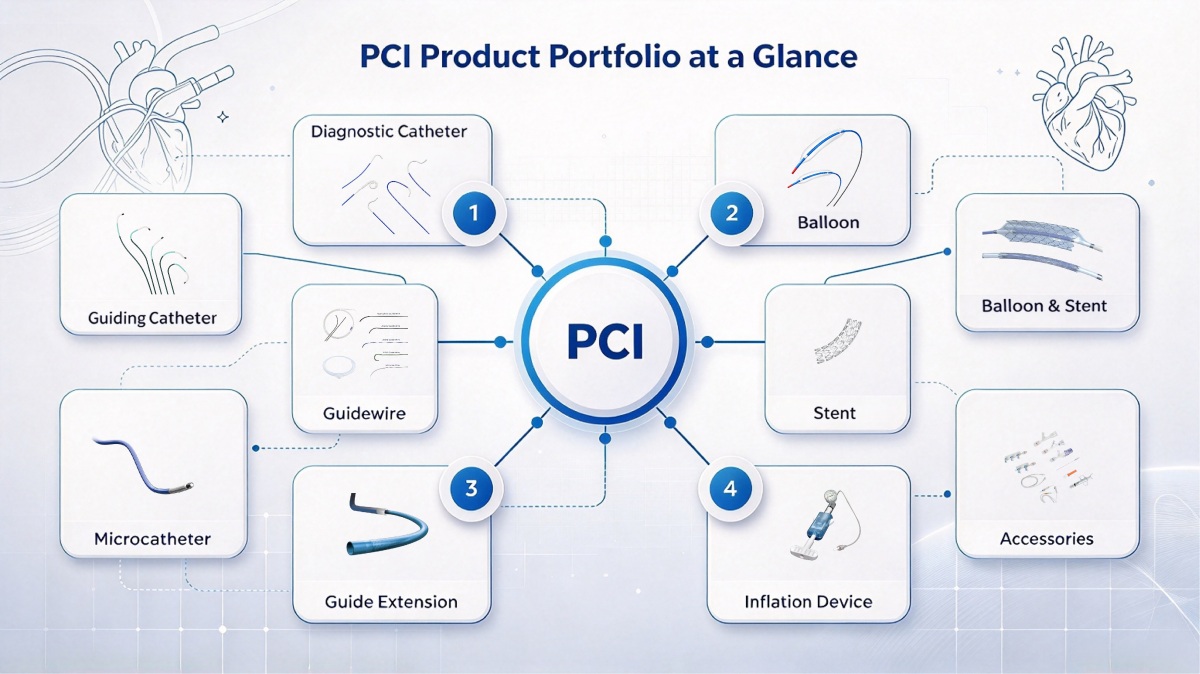
Important: Not every PCI procedure requires every product listed above. The appropriate device combination depends on the anatomy, lesion characteristics, procedural strategy, device compatibility, and the clinician’s judgment. While building an expanded PCI portfolio brings one‑stop‑sourcing benefits, distributors should also evaluate local market procedure volume: complex CTO‑oriented wires or microcatheters may see low turnover in markets dominated by routine simple PCI cases.
1. Diagnostic Access: Starting with the Right Coronary Catheter
Before an interventional procedure can be performed, coronary anatomy may need to be assessed through coronary angiography.
A diagnostic catheter is commonly used to access the coronary arteries and facilitate contrast injection for angiographic visualization. Cardiac catheterization can be used both to evaluate coronary anatomy and, when appropriate, to proceed toward interventions such as angioplasty and stenting.
For distributors, diagnostic catheters are an important part of a broader PCI portfolio because they create an entry point into the coronary intervention product category.
Key portfolio considerations
A strong diagnostic catheter portfolio can therefore complement a company’s guiding catheter, guidewire, balloon, and stent offerings.
2. Guiding Catheters: Establishing a Stable Interventional Platform
During PCI, a guiding catheter provides a pathway from the vascular access site toward the coronary artery and supports the delivery of interventional devices.
Compared with a diagnostic catheter, a guiding catheter is designed to provide the access and support needed for interventional device delivery.
For a complete PCI product portfolio, guiding catheters should be considered together with:
Access → Guiding Catheter → Guidewire → Balloon / Stent
This product relationship is particularly important for B2B suppliers because customers usually do not purchase these devices as completely isolated products. They often require multiple compatible categories from the same supplier.
What distributors should evaluate
When evaluating a guiding catheter portfolio, consider:
The objective is not simply to maximize the number of SKUs. A better strategy is to establish a focused, commercially relevant product matrix covering the most frequently requested specifications. Over-expanding SKUs without market demand will inflate inventory pressure for your end customers. Many successful importers choose a lean but high-demand spec matrix.
3. Coronary Guidewires: The Core Navigation Component
The coronary guidewire is one of the most important components in a PCI product portfolio.
A guidewire provides a pathway for other interventional devices and is advanced through the coronary vasculature toward the target lesion. During PCI, balloons and other devices can be delivered over the guidewire.
For this reason, guidewires should not be treated as a single product category.
A commercially useful coronary guidewire portfolio can be divided into several functional groups:
Workhorse Guidewires
Designed for general coronary intervention applications, workhorse wires typically form the foundation of a coronary guidewire portfolio.
Hydrophilic Guidewires
Hydrophilic coatings can provide a different surface interaction and are commonly considered when navigation through challenging anatomy is required.
Specialty Guidewires
Specialized wire designs may address specific procedural requirements, including more demanding lesion-crossing situations.
CTO-Oriented Guidewires
Chronic total occlusion (CTO) interventions may require specialized guidewire strategies and supporting devices[2]. Complex PCI can require additional approaches beyond straightforward lesion treatment.
Key guidewire specifications
For B2B procurement, distributors typically need to compare:
This is why a guidewire family, rather than one guidewire SKU, is usually more valuable to a distributor.
4. Balloon Catheters: Lesion Preparation and Vessel Dilation
Balloon catheters are another fundamental component of PCI.
During coronary angioplasty, a balloon catheter can be positioned across a narrowed area and inflated to enlarge the lumen. When stenting is performed, a stent may be mounted on a balloon delivery system and expanded at the target site.
For a B2B product portfolio, balloon catheters can be organized according to their intended role and specifications.
Typical portfolio dimensions
Diameter:
Different vessel and lesion dimensions require different balloon diameters.
Length:
Different lesion lengths and treatment strategies require different balloon lengths.
Pressure performance:
Working pressure and rated burst pressure are important technical parameters for product selection.
Crossing and deliverability:
The catheter structure, shaft design, tip profile, and coating can influence delivery performance.
A comprehensive balloon portfolio therefore needs more than a wide list of sizes. It should provide a logical specification matrix that allows distributors to match products with their target markets.
5. Coronary Stents: The Implantable Component of PCI
A coronary stent is a small mesh-like scaffold that is placed inside a coronary artery to help maintain vessel patency after treatment. Modern coronary angioplasty frequently involves stent placement, although the exact treatment strategy depends on the clinical situation[3].
For distributors, stents represent a different product category from disposable delivery devices because they involve:
Therefore, a supplier offering coronary stents should be able to provide much more than a product catalogue.
The commercial package should ideally include:
Product specifications + regulatory documentation + quality information + packaging information + traceability + supply capability
For OEM/ODM customers, customization and product-development capabilities can also become important differentiators.
6. Microcatheters and Guide Extension Catheters
As PCI portfolios become more comprehensive, supporting catheter products become increasingly important.
Microcatheters
Microcatheters can provide additional support and facilitate guidewire management in selected coronary interventions, particularly in more complex procedures.
For distributors serving physicians and hospitals with advanced PCI capabilities, a microcatheter portfolio can complement coronary guidewires and CTO-oriented products.
Guide Extension Catheters
A guide extension catheter can provide additional distal support and assist with delivery of interventional devices in selected anatomies.
From a portfolio perspective, these products are important because they expand the supplier’s offering beyond the basic:
Guidewire + Balloon + Stent
model.
They allow an OEM supplier to move toward a more complete coronary intervention solution.
7. Inflation Devices and Procedural Accessories
A complete PCI portfolio should also consider the supporting devices used around balloon and catheter procedures.
Inflation Devices
An inflation device is used to control balloon inflation and monitor pressure during balloon-based interventions.
For procurement teams, important considerations may include:
Y-Connectors and Other Accessories
Accessories may include components used to connect, control, or support catheter-based procedures.
Although these products may have a lower unit value than major interventional devices, they can have significant commercial importance when customers prefer one-stop sourcing.
8. How the Products Work Together as a PCI Solution
The real value of a complete PCI portfolio becomes clearer when the products are viewed as a connected system.
A simplified PCI product pathway
1. Access
Vascular access is established using an appropriate access system.
↓
2. Diagnostic Assessment
A diagnostic catheter may be used to visualize the coronary anatomy.
↓
3. Interventional Access
A guiding catheter establishes the interventional pathway and provides support.
↓
4. Lesion Crossing
A coronary guidewire is advanced toward and across the target lesion as appropriate.
↓
5. Lesion Preparation
A balloon catheter may be used for lesion preparation or dilation.
↓
6. Stent Delivery
When stenting is indicated, a coronary stent delivery system is positioned and deployed.
↓
7. Additional Support
Depending on anatomy and procedural requirements, microcatheters, guide extension catheters, additional balloons, or other accessories may be used.
↓
8. Final Assessment
The result is assessed using appropriate imaging and procedural evaluation.
This workflow demonstrates why a PCI solution supplier can provide greater value than a supplier selling only one product category[4].
This workflow describes a typical elective PCI procedure; emergency PCI for ACS or complex CTO cases deviates significantly from this sequence[5].
9. Why a Complete PCI Product Portfolio Matters to Distributors
For a medical device distributor, purchasing individual products from multiple suppliers can create several challenges.
Multiple suppliers can mean:
A consolidated PCI portfolio can simplify these processes.
One portfolio, multiple product categories
Instead of sourcing:
Guidewires from Supplier A
Catheters from Supplier B
Balloons from Supplier C
Accessories from Supplier D
a distributor may prefer to establish a relationship with an OEM supplier capable of providing multiple product families.
This is particularly valuable for distributors developing their own brands or expanding into new coronary intervention markets.
10. What to Look for in a PCI OEM Supplier
Choosing a PCI OEM supplier should go beyond comparing unit prices.
A reliable evaluation framework should include at least six dimensions.
01 — Product Portfolio
Does the supplier cover the product categories your market actually needs?
02 — Manufacturing Capability
Can the supplier consistently manufacture the required products and specifications?
03 — Quality System
Are production, inspection, sterilization, packaging, and traceability processes appropriately controlled?
04 — Regulatory Support
Can the supplier provide the technical and regulatory documentation required for the target market?
05 — Customization Capability
Can the supplier support OEM/ODM requirements such as specifications, packaging, labeling, branding, and selected product configurations?
06 — Supply Stability
Can the supplier provide consistent lead times, production capacity, quality consistency, and after-sales communication?
For international B2B customers, these factors may be more important than simply finding the lowest quotation.
11. From Individual Products to Complete PCI Solutions
The medical device market is becoming increasingly competitive.
For distributors, the commercial opportunity is no longer limited to selling a single guidewire or balloon.
A stronger strategy is to build a complete PCI product portfolio around the actual needs of coronary intervention.
For example:
Basic PCI Portfolio
Expanded PCI Portfolio
Advanced / Complex PCI Portfolio
The exact portfolio should be adapted to the target market, regulatory environment, customer profile, and local clinical practice.
12. Why Choose a Multi-Product PCI OEM Partner?
A multi-product OEM partner can help distributors move from single-product sourcing toward solution-based procurement.
The potential advantages include:
Integrated Product Portfolio
Multiple coronary intervention categories from one supply chain.
OEM / ODM Capability
Support for private-label and customized product programs where applicable.
Specification Flexibility
Product configurations can be developed around market requirements.
Quality Consistency
A unified quality-management approach across product families can simplify supplier management.
B2B Supply Efficiency
Consolidated communication, documentation, packaging, and logistics can reduce procurement complexity.
Market Expansion Support
A broader portfolio makes it easier for distributors to expand from a single product category into a complete coronary intervention offering.
13. Complete PCI Solution from Maejet
At Maejet, our approach is to provide more than individual interventional medical devices.
We focus on building a comprehensive coronary intervention product portfolio for distributors, agents, importers, and medical device companies seeking reliable OEM/ODM supply.
Our PCI-related product portfolio can include:
The goal is simple:
One qualified OEM partner. Multiple PCI product categories. A more complete coronary intervention supply solution.
Whether you are building a new private-label product line, expanding an existing coronary intervention portfolio, or looking for an alternative OEM supplier, a complete product strategy can help you reduce supplier complexity while creating a more competitive market offering.
14. FAQ: Complete PCI Product Solutions
What products are commonly included in a PCI product portfolio?
A PCI portfolio may include diagnostic catheters, guiding catheters, coronary guidewires, balloon catheters, coronary stents, microcatheters, guide extension catheters, inflation devices, and procedural accessories. The exact combination depends on the intended application and market.
Are all PCI products required in every procedure?
No. PCI procedures vary according to anatomy, lesion characteristics, procedural strategy, and clinical requirements. A complete PCI portfolio means providing a broad range of compatible product options rather than implying that every device is used in every procedure.
What is the difference between a diagnostic catheter and a guiding catheter?
A diagnostic catheter is primarily used for coronary access and angiographic assessment, while a guiding catheter is designed to provide an interventional pathway and support the delivery of PCI devices.
Why are guidewires important in PCI?
Guidewires provide a pathway for delivering other interventional devices and play an important role in navigating the coronary anatomy during PCI. Different guidewire designs are intended to provide different combinations of support, flexibility, torque response, coating characteristics, and lesion-crossing performance[6].
Why should distributors consider a multi-product PCI supplier?
A multi-product supplier can simplify supplier qualification, technical communication, documentation, purchasing, logistics, and portfolio expansion compared with managing multiple independent suppliers.
Can an OEM supplier provide a complete PCI product line?
Depending on the manufacturer’s capabilities, regulatory scope, and product portfolio, an OEM supplier may support multiple PCI product categories. Before cooperation, distributors should verify the supplier’s manufacturing capabilities, quality system, regulatory documentation, product specifications, and target-market registration status.
Conclusion
A successful PCI product strategy is not simply about having more SKUs.
It is about creating a structured, compatible, scalable, and commercially relevant product portfolio that covers the major stages of coronary intervention.
From diagnostic and guiding catheters to coronary guidewires, balloons, stents, microcatheters, guide extension catheters, inflation devices, and accessories, each product category can play a different role within the broader PCI ecosystem.
For distributors and importers, working with a capable multi-product OEM partner can turn fragmented product sourcing into a more efficient complete PCI intervention product solution.
Looking for a complete PCI product portfolio or OEM/ODM partner?
Contact Maejet to discuss your product requirements, target market, specifications, and private-label program.
Medical & Regulatory Disclaimer
This content is exclusively intended for B2B audiences including medical device distributors, importers, OEM partners and hospital procurement teams, not for patients or clinical end‑users. It does not constitute medical advice or clinical practice guidance. Device indications, allowed specifications, regulatory clearance status vary significantly across countries. All clinical usage must strictly follow local approved IFU (Instructions for Use), clinical guidelines and national regulatory requirements. Final clinical decision‑making rests with treating interventional cardiologists.
References
[1] Ahmad M, et al. Percutaneous Coronary Intervention. StatPearls [Internet]. NCBI Bookshelf.
[2] Galassi AR, Vadalà G, Werner GS, et al. Evaluation and management of patients with coronary chronic total occlusions considered for revascularisation: A clinical consensus statement of the European Association of Percutaneous Cardiovascular Interventions (EAPCI) of the ESC, the European Association of Cardiovascular Imaging (EACVI) of the ESC, and the ESC Working Group on Cardiovascular Surgery. EuroIntervention. 2024;20(3):e174-e184. doi:10.4244/EIJ-D-23-00749.
[3] Lawton JS, Tamis-Holland JE, Bangalore S, et al. 2021 ACC/AHA/SCAI Guideline for Coronary Artery Revascularization: A Report of the American College of Cardiology/American Heart Association Joint Committee on Clinical Practice Guidelines. Circulation. 2022;145:e18-e114. doi:10.1161/CIR.0000000000001038.
[4] DeVos AN, Reifart J, Valenzuela TF, Cangemi S, Iaizzo PA. Percutaneous Coronary Intervention: Devices, Research, and Clinical Implications. In: Iaizzo PA, ed. Handbook of Cardiac Anatomy, Physiology, and Devices. 4th ed. Springer Nature; 2024:805-833. doi:10.1007/978-3-031-72581-4_40.
[5] Byrne RA, Rossello X, Coughlan JJ, et al. 2023 ESC Guidelines for the management of acute coronary syndromes: Developed by the task force on the management of acute coronary syndromes of the European Society of Cardiology (ESC). Eur Heart J. 2023;44(38):3720-3826. doi:10.1093/eurheartj/ehad191.
[6] Naidu SS, Abbott JD, Bagai J, et al. SCAI expert consensus update on best practices in the cardiac catheterization laboratory. Catheter Cardiovasc Interv. 2021;98(2):255-276. doi:10.1002/ccd.29744.


 English
 русский
 español
 العربية
 Indonesia