PTCA vs. PCI: Key Differences, Procedures & Devices Explained | Maejet
Discover the key differences between PTCA and PCI, including definitions, procedures, indications, advantages, and the interventional devices used in modern coronary artery disease treatment.
PTCA vs. PCI: What's the Difference?
PTCA and PCI are two terms frequently used in interventional cardiology. Although many people use them interchangeably, they are not exactly the same.
If you're a physician, distributor, hospital buyer, or medical device importer, understanding the distinction between these procedures is essential when selecting products, communicating with clinical teams, or sourcing interventional devices.
In this guide, we'll explain:
What PTCA is
What PCI is
The key differences between PTCA and PCI
Why PCI has become today's standard treatment
The devices commonly used during PCI procedures
Ι What Is PTCA?
PTCA (Percutaneous Transluminal Coronary Angioplasty) is a minimally invasive procedure designed to restore blood flow in narrowed or blocked coronary arteries using a balloon catheter.
Introduced by Dr. Andreas Grüntzig in 1977, PTCA marked the beginning of modern coronary intervention by providing an effective alternative to open-heart surgery.
How PTCA Works
A guidewire crosses the coronary lesion.
A balloon catheter is advanced over the guidewire.
The balloon is inflated to compress the plaque against the arterial wall.
Blood flow is restored.
Originally, PTCA referred specifically to balloon angioplasty without routine stent implantation.
Ι What Is PCI?
PCI (Percutaneous Coronary Intervention) is the broader term that describes all catheter-based procedures used to treat coronary artery disease.
Modern PCI includes much more than balloon angioplasty.
Today, PCI may involve:
Balloon angioplasty
Drug-eluting stent (DES) implantation
Bare-metal stent implantation
Drug-coated balloons (DCB)
Atherectomy procedures
IVUS-guided intervention
OCT-guided intervention
FFR or iFR physiological assessment
In simple terms:
♦ PTCA is one technique within the broader category of PCI.
In our experience supplying coronary intervention products to hospitals and distributors worldwide, many customers mistakenly believe PTCA and PCI are interchangeable terms. In reality, PTCA is only one component of the broader PCI strategy.
Ι PTCA vs. PCI: Key Differences
Feature
PTCA
PCI
Full Name
Percutaneous Transluminal Coronary Angioplasty
Percutaneous Coronary Intervention
Scope
Balloon angioplasty only
Comprehensive coronary intervention
Balloon Angioplasty
✓
✓
Stent Implantation
Usually No
Usually Yes
Drug-Coated Balloon
No
Yes
Atherectomy
No
Yes
IVUS / OCT Guidance
Rare
Common
Current Clinical Use
Limited
Standard of care
The biggest difference is that PTCA refers only to balloon angioplasty, whereas PCI encompasses all modern catheter-based coronary interventions.
Why Has PCI Replaced Traditional PTCA?
While balloon angioplasty alone can successfully open narrowed arteries, it has several limitations.
After balloon dilation, the artery may:
Recoil
Collapse
Develop restenosis due to tissue growth
Modern PCI addresses these issues by combining balloon angioplasty with additional technologies such as drug-eluting stents and intravascular imaging.
Advantages of PCI
Lower restenosis rates
Better long-term vessel patency
Higher procedural success rates
Improved outcomes for complex coronary lesions
Reduced need for repeat interventions
Because of these advantages, PCI has become the preferred treatment for most patients with coronary artery disease worldwide.
Ι When Is PTCA Still Used?
Although PCI is now the standard approach, balloon angioplasty remains an important component of many procedures.
PTCA may still be appropriate in cases such as:
Lesion pre-dilation before stenting
Small vessel disease
Drug-coated balloon therapy
Selected pediatric interventions
Specific clinical scenarios where permanent stents are not preferred
In most modern procedures, however, balloon angioplasty is performed as one step within a PCI procedure.
Ι Common Devices Used During PCI
Successful PCI relies on multiple specialized interventional devices working together.
Device
Primary Function
Coronary Guidewire
Crosses the coronary lesion
Diagnostic Catheter
Coronary angiography
Guiding Catheter
Delivers interventional devices
PTCA Balloon Catheter
Dilates stenotic lesions
Drug-Eluting Stent
Maintains vessel patency
Inflation Device
Controls balloon inflation pressure
Microcatheter
Provides guidewire support
Hemostasis Valve
Prevents blood loss during intervention
High-quality interventional devices contribute significantly to procedural efficiency, physician control, and patient outcomes.
PTCA vs. PCI: Which One Is Better?
The answer depends on the clinical situation.
For most coronary artery disease cases, PCI provides superior long-term outcomes because it incorporates advanced technologies beyond balloon angioplasty alone.
PTCA remains an essential technique, but it is now considered one component of the broader PCI strategy rather than a standalone treatment in most patients.
Frequently Asked Questions
Is PTCA the same as PCI?
No.
PTCA refers specifically to balloon angioplasty, while PCI includes balloon angioplasty, stent implantation, drug-coated balloons, atherectomy, and other catheter-based coronary interventions.
Does every PCI require a stent?
No.
Some PCI procedures use drug-coated balloons or other treatment strategies without permanent stent implantation.
Why is PCI more commonly performed today?
PCI offers:
Lower restenosis rates
Better long-term outcomes
Improved treatment for complex coronary lesions
Greater procedural success
Is balloon angioplasty still important?
Absolutely.
Balloon angioplasty remains a fundamental step in many PCI procedures and continues to play a vital role in coronary intervention.
Conclusion
Although the terms PTCA and PCI are often used interchangeably, they represent different concepts.
PTCA specifically describes balloon angioplasty, while PCI refers to the complete range of modern catheter-based coronary interventions used to treat coronary artery disease.
As interventional cardiology continues to evolve, PCI has become the global standard of care, supported by increasingly sophisticated guidewires, balloon catheters, guiding catheters, coronary stents, microcatheters, and inflation devices.
For hospitals, distributors, and healthcare providers, understanding this distinction helps ensure better communication, more accurate product selection, and improved clinical outcomes.
Related Products
Coronary Guidewires
PTCA Balloon Catheters
Guiding Catheters
Diagnostic Catheters
Inflation Devices
Coronary Stents
Microcatheters
Hemostasis Valves
Recommended Reading
How PTCA Balloon Catheters Work in Coronary Intervention
Drug-Eluting Stents vs. Bare-Metal Stents
Choosing the Right Coronary Guidewire for Complex PCI
Complete Guide to Coronary Angiography Catheters
Guidewire Selection for CTO Procedures
Contact Us
Looking for a reliable supplier of PCI and PTCA interventional devices?
We provide a comprehensive portfolio of high-quality coronary intervention products, including guidewires, balloon catheters, guiding catheters, diagnostic catheters, inflation devices, and related accessories for global distributors, hospitals, and OEM partners.
Contact our team today to learn more about our coronary intervention solutions.
Introduction
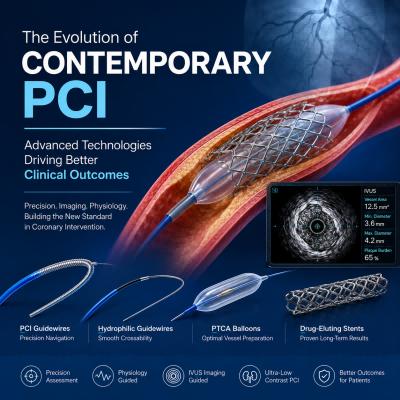
Percutaneous Coronary Intervention (PCI) has undergone a remarkable transformation over the past decade. While coronary angiography remains a cornerstone of diagnosis and treatment planning, today's interventional cardiologists increasingly rely on advanced physiological assessment and intravascular imaging technologies to achieve more precise and predictable outcomes.
The integration of guidewires, physiology-guided assessment, intravascular ultrasound (IVUS), specialty balloons, and modern stent platforms is redefining the standard of care for coronary interventions. As coronary artery disease becomes increasingly complex, the ability to combine these technologies into a streamlined workflow has become essential for optimizing patient outcomes.
Beyond Angiography: The Shift Toward Precision PCI
For many years, angiography served as the primary method for identifying coronary lesions and guiding intervention. However, angiographic images alone often fail to reveal the true physiological significance of a lesion or the detailed morphology of the vessel wall.
Modern PCI increasingly incorporates:
Physiological lesion assessment
Intravascular ultrasound (IVUS)
Co-registration technologies
Advanced guidewire navigation systems
These tools allow physicians to move beyond treating isolated lesions and instead evaluate the entire vessel, identifying areas of ischemia, plaque burden, and vessel dimensions with greater accuracy.
The result is a more individualized treatment strategy that improves procedural success and long-term clinical outcomes.
Managing Increasingly Complex Coronary Disease
Today's PCI patients frequently present with:
Diabetes mellitus
Chronic kidney disease (CKD)
Diffuse coronary artery disease
Calcified lesions
Chronic total occlusions (CTO)
Multi-vessel disease
These complex anatomies require precise lesion crossing, vessel preparation, and stent optimization.
Advanced coronary guidewires play a critical role in this process. Modern workhorse, hydrophilic, and CTO guidewires provide enhanced torque response, trackability, and support, allowing operators to safely navigate challenging lesions.
When combined with IVUS imaging, physicians can accurately determine:
Vessel diameter
Lesion length
Plaque composition
Calcium distribution
Optimal landing zones for stent deployment
This comprehensive understanding helps reduce geographic miss and improves procedural efficiency.
Ultra-Low Contrast PCI: Protecting Renal Function
Contrast-induced acute kidney injury remains a significant concern, particularly among patients with pre-existing renal dysfunction.
The emergence of ultra-low contrast PCI techniques has created new opportunities to safely treat patients who were previously considered high risk.
Key enabling technologies include:
Physiological Guidance
Pressure guidewires provide functional assessment of coronary stenosis, helping physicians identify lesions that truly require intervention.
IVUS-Guided PCI
IVUS enables accurate vessel sizing and procedural optimization while reducing dependence on repeated contrast injections.
Advanced Guidewire Navigation
Hydrophilic coronary guidewires and micro-guidewire technologies facilitate vessel access and lesion crossing with fewer angiographic runs.
Together, these technologies support safer interventions while minimizing nephrotoxic contrast exposure.
The Critical Role of Intravascular Imaging
Intravascular imaging has become one of the most influential advances in contemporary PCI.
IVUS-guided PCI offers several advantages:
Accurate vessel sizing
Detection of plaque morphology
Identification of calcium burden
Optimization of stent expansion
Verification of stent apposition
Clinical evidence continues to demonstrate that imaging-guided PCI can improve procedural outcomes and reduce adverse events compared with angiography-guided procedures alone.
As a result, many leading catheterization laboratories now consider IVUS-guided PCI a key component of contemporary coronary intervention strategies.
Standardized PCI Workflow Improves Outcomes
Successful PCI is no longer dependent on a single device or technology.
The most effective programs integrate:
Coronary guidewires
Physiological assessment tools
IVUS imaging systems
Specialty balloons
Drug-eluting stents
Advanced imaging platforms
Standardizing these technologies across the catheterization laboratory enables physicians to deliver consistent, high-quality care while improving procedural efficiency.
A standardized workflow can help:
Reduce procedural variability
Improve clinical decision-making
Shorten procedure times
Enhance patient safety
Optimize resource utilization
Future Perspectives
The future of PCI is moving toward increasingly personalized and image-guided intervention.
Emerging technologies are expected to further enhance:
Lesion assessment accuracy
Device selection
Stent optimization
Contrast reduction strategies
Complex lesion treatment
As physiological assessment, IVUS imaging, and advanced guidewire technologies become more widely adopted, interventional cardiologists will be better equipped to achieve superior outcomes even in the most challenging coronary anatomies.
Conclusion
Contemporary PCI is evolving beyond traditional angiography-guided intervention. The combination of advanced guidewires, intravascular imaging, physiological assessment, and optimized treatment workflows is creating a new standard for precision coronary intervention.
For healthcare providers seeking to improve procedural success and patient outcomes, adopting a comprehensive technology-driven PCI strategy is no longer an option—it is becoming the benchmark for modern cardiovascular care.
As a global supplier of coronary intervention devices, we are committed to supporting physicians with high-quality guidewires, micro guidewires, PTCA balloons, and related interventional solutions designed to meet the demands of today's complex PCI procedures.





 English
 русский
 español
 العربية
 Indonesia