A Practical Guide to Evaluating Coronary Intervention Devices, Manufacturers, and Medical Device Suppliers
Introduction: Choosing PCI Devices Is More Than Choosing Products
The global demand for Percutaneous Coronary Intervention (PCI) devices continues to grow as hospitals and cardiovascular centers perform more minimally invasive coronary procedures.
For medical device distributors, importers, and regional agents, selecting PCI devices is not simply a purchasing decision. It is a long-term business decision that directly affects:
Hospital trust
Market reputation
Regulatory approval efficiency
Customer retention
Supply chain stability
Many buyers initially compare suppliers based on product specifications and price. However, experienced distributors understand that a successful PCI product line depends on much more than competitive pricing.
A reliable PCI device supplier should provide consistent product performance, stable manufacturing capability, regulatory support, and the ability to grow together in different markets.
This article explains how professional buyers evaluate high-quality PCI devices and select the right manufacturing partner.
1. Start With Understanding Your PCI Product Requirements
Before evaluating suppliers, distributors should first understand what products their target market actually needs.
A complete PCI solution usually includes several key devices:
Coronary Guidewires
Coronary guidewires are among the most technically demanding devices in PCI procedures.
Their performance directly influences device delivery and lesion crossing.
When evaluating guidewires, professional buyers usually focus on:
Tip flexibility and safety
Torque transmission
Lubricity during vessel navigation
Support force
Shape memory
Performance consistency between batches
For example, hospitals treating complex lesions may require different guidewire characteristics compared with routine PCI procedures.
A supplier that understands clinical applications can help distributors select more suitable products instead of simply offering standard models.
PTCA Balloon Catheters
Balloon catheters play an essential role in lesion preparation and vessel expansion.
Important performance factors include:
Low crossing profile
Controlled balloon expansion
Reliable pressure resistance
Smooth delivery performance
Accurate sizing options
For distributors, product availability across different diameters and lengths is also important because hospitals usually require multiple configurations.
Coronary Stents
Coronary stents require strict control of materials, design, and manufacturing processes.
Key evaluation points include:
Stent platform design
Radial strength
Flexibility
Delivery system performance
Drug coating technology
Long-term product stability
A competitive stent supplier should not only provide products but also provide technical documentation and market support.
Supporting PCI Accessories
Many distributors prefer suppliers who can provide a broader product portfolio, including:
Guiding catheters
Diagnostic catheters
Inflation devices
Y-connectors
Introducer sheaths
A complete product range helps distributors simplify procurement and improve customer service.
2. Product Quality Should Be Evaluated From Manufacturing Details
Medical devices used in cardiovascular intervention require extremely high manufacturing precision.
A small difference in material processing, coating technology, or assembly control may influence clinical performance.
When assessing a PCI device manufacturer, distributors should look beyond product appearance and review:
Material Control
High-quality PCI devices rely on carefully selected medical-grade materials, such as:
Stainless steel alloys
Nitinol materials
Medical polymers
Hydrophilic coating materials
Material selection affects flexibility, durability, and device handling characteristics.
Manufacturing Process Control
Reliable manufacturers usually have controlled production systems covering:
Incoming material inspection
Precision processing
Cleanroom assembly
Sterilization validation
Final product testing
Batch traceability
For global buyers, manufacturing consistency is often more important than a single product sample.
A product that performs well once but lacks batch-to-batch stability creates significant commercial risks.
3. Verify Regulatory Capability Before Starting Cooperation
For international medical device distribution, regulatory compliance is one of the most important supplier evaluation criteria.
A qualified PCI device manufacturer should understand different market requirements and provide necessary documentation.
Important factors include:
Quality Management System
Distributors should check whether the supplier operates according to internationally recognized quality systems, such as:
ISO 13485 medical device quality management system
Document control procedures
Product traceability systems
Quality inspection processes
Export Experience
A supplier with international market experience usually understands:
Registration requirements
Import documentation
Distributor cooperation models
Local market expectations
This can significantly reduce communication costs during market expansion.
4. Evaluate Whether the Supplier Can Support Your Business Growth
For distributors, choosing a PCI supplier is not only about today's order.
The better question is:
Can this supplier support our business development in the next five years?
A strong partner should provide:
Stable Production Capacity
Medical markets require reliable supply.
Distributors should understand:
Monthly production capability
Lead time stability
Inventory management ability
Emergency order handling
OEM and Customization Capability
Different countries may have different market requirements.
Flexible suppliers can support:
Private label products
Customized packaging
Product configuration adjustments
Documentation preparation
Distributor branding strategies
This is especially valuable for regional distributors building their own medical device brands.
Technical and Marketing Support
Successful medical device suppliers often provide more than products.
Additional support may include:
Product training
Technical documents
Product comparison materials
Application guidance
Sales support materials
These resources help distributors communicate product value to hospitals and healthcare professionals.
5. Price Matters, But Total Value Matters More
A common mistake among new buyers is selecting suppliers only based on unit price.
In the PCI device industry, the lowest price does not always mean the lowest cost.
A cheaper supplier may create additional costs through:
Quality issues
Delivery delays
Registration problems
Customer complaints
Limited product selection
Professional distributors usually evaluate the total partnership value:
Product Quality + Supply Reliability + Regulatory Support + Business Cooperation
This approach creates a more sustainable market strategy.
6. Questions Every Distributor Should Ask Before Selecting a PCI Supplier
Before establishing cooperation, global buyers should consider:
About Products
Are product specifications suitable for our target hospitals?
Can the supplier provide multiple PCI product categories?
How is product consistency controlled?
About Manufacturing
Does the factory have a mature quality management system?
What production processes are internally controlled?
How does the supplier handle quality complaints?
About Cooperation
Can they support OEM projects?
Can they provide export documentation?
Can they support long-term market development?
7. Why Integrated PCI Solutions Are Becoming More Important
The cardiovascular intervention market is becoming increasingly competitive.
Many distributors are moving from purchasing individual products toward working with integrated solution providers.
A comprehensive PCI supplier can help customers build a complete portfolio covering:
Coronary guidewires
PTCA balloon catheters
Coronary stents
Diagnostic catheters
Guiding catheters
PCI accessories
The advantages include:
Easier supply chain management
Consistent quality standards
Faster communication
Better market response
For distributors, this means stronger competitiveness and better customer relationships.
Conclusion: Selecting the Right PCI Partner Creates Long-Term Market Value
Choosing high-quality PCI devices requires a comprehensive evaluation of technology, manufacturing capability, regulatory experience, and supplier reliability.
For global distributors, the ideal PCI supplier is not simply a company that provides products. It is a partner that understands clinical applications, supports market development, and provides stable solutions over the long term.
By working with a reliable PCI device manufacturer, distributors can build stronger product portfolios, improve customer confidence, and create sustainable growth in the cardiovascular intervention market.
Frequently Asked Questions (FAQ)
What should distributors consider when selecting PCI devices?
Distributors should evaluate product performance, manufacturing quality, regulatory compliance, supply stability, and supplier support capability.
What products are included in PCI devices?
PCI devices commonly include coronary guidewires, PTCA balloon catheters, coronary stents, guiding catheters, diagnostic catheters, and related accessories.
How can I find a reliable PCI device supplier?
Look for manufacturers with proven production capability, ISO 13485 quality systems, international export experience, and OEM/ODM support.
Why choose a complete PCI solution supplier?
An integrated supplier helps distributors simplify procurement, improve supply stability, and provide more complete solutions to hospitals.
CTA
Looking for a reliable PCI device supplier for your market?
Our team provides coronary intervention solutions for global distributors, importers, and medical device partners.
Contact us to discuss your product requirements and partnership opportunities.
Introduction
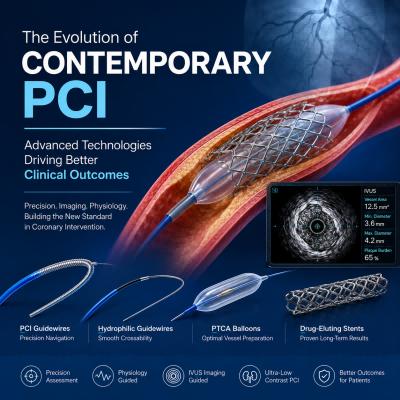
Percutaneous Coronary Intervention (PCI) has undergone a remarkable transformation over the past decade. While coronary angiography remains a cornerstone of diagnosis and treatment planning, today's interventional cardiologists increasingly rely on advanced physiological assessment and intravascular imaging technologies to achieve more precise and predictable outcomes.
The integration of guidewires, physiology-guided assessment, intravascular ultrasound (IVUS), specialty balloons, and modern stent platforms is redefining the standard of care for coronary interventions. As coronary artery disease becomes increasingly complex, the ability to combine these technologies into a streamlined workflow has become essential for optimizing patient outcomes.
Beyond Angiography: The Shift Toward Precision PCI
For many years, angiography served as the primary method for identifying coronary lesions and guiding intervention. However, angiographic images alone often fail to reveal the true physiological significance of a lesion or the detailed morphology of the vessel wall.
Modern PCI increasingly incorporates:
Physiological lesion assessment
Intravascular ultrasound (IVUS)
Co-registration technologies
Advanced guidewire navigation systems
These tools allow physicians to move beyond treating isolated lesions and instead evaluate the entire vessel, identifying areas of ischemia, plaque burden, and vessel dimensions with greater accuracy.
The result is a more individualized treatment strategy that improves procedural success and long-term clinical outcomes.
Managing Increasingly Complex Coronary Disease
Today's PCI patients frequently present with:
Diabetes mellitus
Chronic kidney disease (CKD)
Diffuse coronary artery disease
Calcified lesions
Chronic total occlusions (CTO)
Multi-vessel disease
These complex anatomies require precise lesion crossing, vessel preparation, and stent optimization.
Advanced coronary guidewires play a critical role in this process. Modern workhorse, hydrophilic, and CTO guidewires provide enhanced torque response, trackability, and support, allowing operators to safely navigate challenging lesions.
When combined with IVUS imaging, physicians can accurately determine:
Vessel diameter
Lesion length
Plaque composition
Calcium distribution
Optimal landing zones for stent deployment
This comprehensive understanding helps reduce geographic miss and improves procedural efficiency.
Ultra-Low Contrast PCI: Protecting Renal Function
Contrast-induced acute kidney injury remains a significant concern, particularly among patients with pre-existing renal dysfunction.
The emergence of ultra-low contrast PCI techniques has created new opportunities to safely treat patients who were previously considered high risk.
Key enabling technologies include:
Physiological Guidance
Pressure guidewires provide functional assessment of coronary stenosis, helping physicians identify lesions that truly require intervention.
IVUS-Guided PCI
IVUS enables accurate vessel sizing and procedural optimization while reducing dependence on repeated contrast injections.
Advanced Guidewire Navigation
Hydrophilic coronary guidewires and micro-guidewire technologies facilitate vessel access and lesion crossing with fewer angiographic runs.
Together, these technologies support safer interventions while minimizing nephrotoxic contrast exposure.
The Critical Role of Intravascular Imaging
Intravascular imaging has become one of the most influential advances in contemporary PCI.
IVUS-guided PCI offers several advantages:
Accurate vessel sizing
Detection of plaque morphology
Identification of calcium burden
Optimization of stent expansion
Verification of stent apposition
Clinical evidence continues to demonstrate that imaging-guided PCI can improve procedural outcomes and reduce adverse events compared with angiography-guided procedures alone.
As a result, many leading catheterization laboratories now consider IVUS-guided PCI a key component of contemporary coronary intervention strategies.
Standardized PCI Workflow Improves Outcomes
Successful PCI is no longer dependent on a single device or technology.
The most effective programs integrate:
Coronary guidewires
Physiological assessment tools
IVUS imaging systems
Specialty balloons
Drug-eluting stents
Advanced imaging platforms
Standardizing these technologies across the catheterization laboratory enables physicians to deliver consistent, high-quality care while improving procedural efficiency.
A standardized workflow can help:
Reduce procedural variability
Improve clinical decision-making
Shorten procedure times
Enhance patient safety
Optimize resource utilization
Future Perspectives
The future of PCI is moving toward increasingly personalized and image-guided intervention.
Emerging technologies are expected to further enhance:
Lesion assessment accuracy
Device selection
Stent optimization
Contrast reduction strategies
Complex lesion treatment
As physiological assessment, IVUS imaging, and advanced guidewire technologies become more widely adopted, interventional cardiologists will be better equipped to achieve superior outcomes even in the most challenging coronary anatomies.
Conclusion
Contemporary PCI is evolving beyond traditional angiography-guided intervention. The combination of advanced guidewires, intravascular imaging, physiological assessment, and optimized treatment workflows is creating a new standard for precision coronary intervention.
For healthcare providers seeking to improve procedural success and patient outcomes, adopting a comprehensive technology-driven PCI strategy is no longer an option—it is becoming the benchmark for modern cardiovascular care.
As a global supplier of coronary intervention devices, we are committed to supporting physicians with high-quality guidewires, micro guidewires, PTCA balloons, and related interventional solutions designed to meet the demands of today's complex PCI procedures.





 English
 русский
 español
 العربية
 Indonesia